
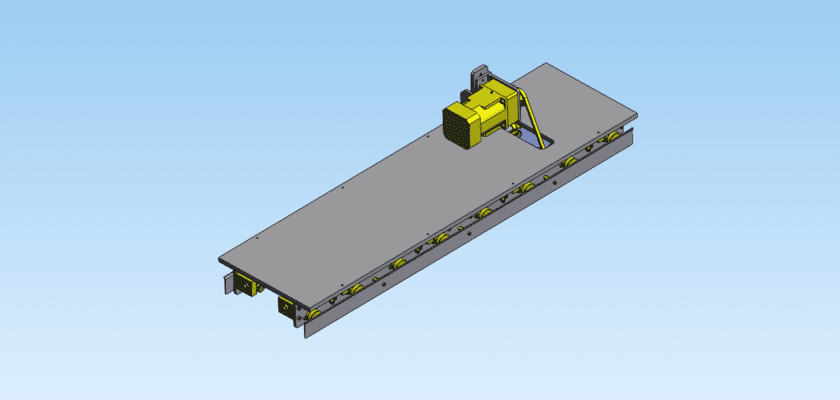
Revolutionize your assembly line with our cutting-edge Non-Contact Drive Conveyor Mechanism technical drawing. Traditional conveyors rely on belts, chains, or rollers that create friction, noise, and wear particles; however, this non-contact system utilizes magnetic or air-cushion principles to transmit motion without physical coupling. This makes it the ultimate solution for cleanroom environments, pharmaceutical production, or high-precision electronics assembly where contamination and vibration must be strictly controlled.
The drawing provides a meticulous breakdown of the drive architecture, focusing on the gap tolerances and alignment required for efficient power transmission. By eliminating physical contact between the drive unit and the carrier, this mechanism significantly reduces maintenance requirements and extends the operational lifespan of the entire system. The CAD-ready documentation includes detailed schematics for the magnet arrays or air-nozzle configurations, as well as the structural frame designed to prevent magnetic interference with surrounding equipment.
By downloading this drawing, you gain access to a sophisticated engineering blueprint that prioritizes silent operation and high-speed stability. The design accounts for the unique physics of non-contact propulsion, including braking dynamics and carrier stability at high velocities. Whether you are building a laboratory automation system or a high-end food processing line, this resource offers the technical precision needed to implement a frictionless, future-proof transport solution.
Características principales:
- Frictionless Power Transmission: Operates without physical contact, eliminating the need for lubrication and reducing the risk of component wear.
- Operación libre de contaminación: Ideal for ISO-rated cleanrooms as it generates zero dust or particles during the material handling process.
- Ultra-Quiet Motion Profile: The absence of mechanical friction results in nearly silent operation, even at high throughput speeds.
- Minimal Maintenance Design: With fewer moving parts in direct contact, the system requires significantly less downtime for repairs and part replacements.
- Posicionamiento de alta precisión: Engineered to work with feedback sensors for millimetric accuracy in stop-and-go automation tasks.


