
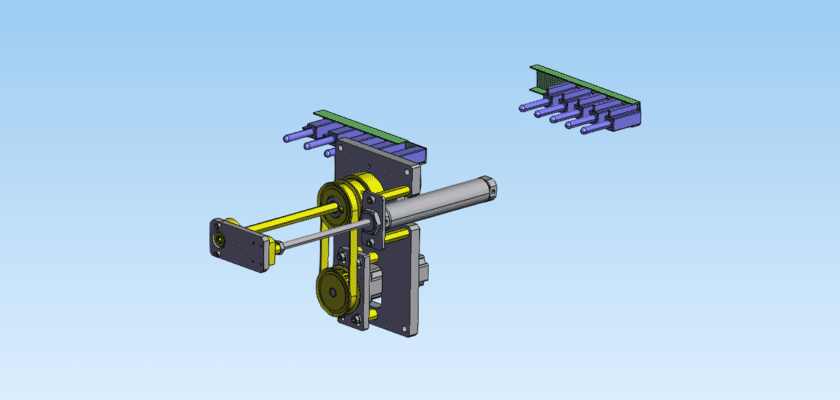
Achieve sophisticated motion control by choosing to download our professional Lifting and Rotating Mechanism using Ball Spline drawing. In high-speed automation and robotics, the ability to perform simultaneous vertical lifting and angular rotation on a single shaft is a critical requirement for pick-and-place operations and assembly tasks. This technical drawing provides a detailed mechanical blueprint of an integrated actuator system that leverages the unique properties of a ball spline. It is an essential asset for mechanical engineers designing high-speed transfer units or precision Z-Theta axes where friction must be minimized and torque transmission must remain constant during travel.
By utilizing this comprehensive CAD resource, you can analyze the specialized architecture of the ball spline nut and shaft, which allows for high-load linear movement without sacrificing rotational rigidity. The drawing details the mounting of servo motor interfaces, belt-drive reductions, and the precision bearings required to manage combined radial and axial loads. Whether you are developing a SCARA robot arm component or an automated laboratory sampling system, these schematics provide the exact dimensions for stroke limits, spline tolerances, and housing clearances. Accessing this verified design allows your team to implement a compact, low-backlash solution that outperforms traditional separate cylinder and rotary motor setups.
Caractéristiques principales :
- Simultaneous Dual-Axis Motion: Detailed schematics of the ball spline interface that enables fluid, non-binding vertical movement during high-torque rotation.
- Low-Friction Recirculating Ball Paths: Structural insights into the spline nut design, engineered for high-speed operation with minimal heat generation.
- High Torsional Rigidity: Specifications for the spline shaft profile that ensures zero-backlash torque transmission, critical for precise angular positioning.
- Compact Actuator Integration: An architectural layout that combines linear and rotary drive inputs into a single, space-saving mechanical assembly.
- Precision Limit and Home Sensing: Integrated mounting points for proximity sensors to ensure safe and repeatable travel across both axes of motion.


