
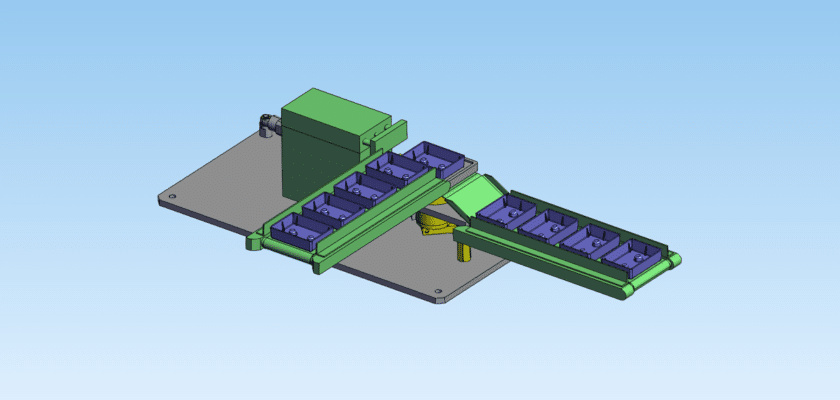
Enhance your surface finishing and material processing equipment with our professional Oscillating Worktable technical drawing. Designed for applications that require consistent, repetitive back-and-forth or orbital motion, this worktable mechanism is essential for industrial sanding, polishing, and specialized vibratory feeding systems. By incorporating a controlled oscillation, the worktable prevents heat buildup and ensures an even distribution of wear across abrasive surfaces, leading to a superior finish on wood, metal, or composite workpieces.
The drawing provides a comprehensive mechanical breakdown of the drive system, typically utilizing an eccentric cam or a crank-slider linkage to convert rotary motor input into smooth, linear oscillation. The architecture focuses on vibration isolation and structural damping to ensure that the reciprocating forces do not compromise the stability of the machine frame. The CAD-ready documentation includes detailed views of the linear guide rails, bearing supports, and adjustable stroke mechanisms, allowing you to fine-tune the oscillation frequency and amplitude to suit your specific manufacturing needs.
By downloading this technical resource, you gain access to a precision-engineered blueprint that prioritizes durability and low maintenance. The design accounts for the dynamic loads associated with high-frequency movement, specifying the necessary tolerances for pivot points and sliding interfaces. Whether you are a custom tool builder or an automation engineer, this resource provides the technical foundation needed to build a reliable, high-performance oscillating platform.
Caractéristiques principales :
- Adjustable Stroke Amplitude: Features a versatile eccentric drive design that allows users to modify the range of motion for different finishing requirements.
- Vibration Damping Mounts: Engineered with integrated damping zones to minimize the transfer of kinetic energy to the main machine base.
- Precision Linear Guidance: Utilizes high-quality rail and block systems to ensure the table remains perfectly level throughout the oscillation cycle.
- High-Cycle Linkage Design: The drive components are optimized for continuous operation, reducing the risk of fatigue failure in 24/7 production environments.
- Sealed Drive Housing: The blueprint includes provisions for protective bellows or seals to prevent dust and debris from entering the moving mechanical parts.


