
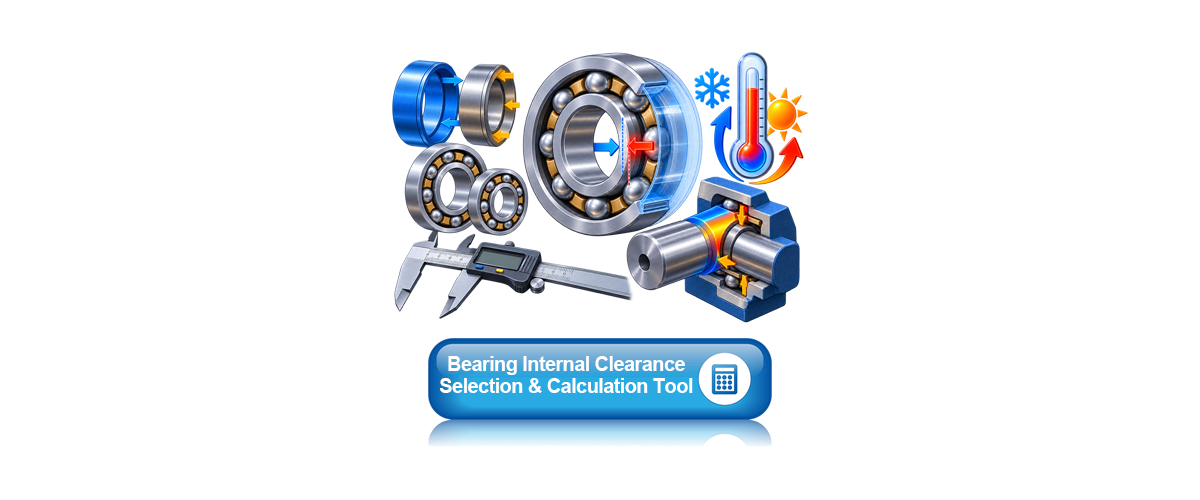
Сайт Bearing Internal Clearance Selection & Calculation Tool is a practical engineering solution designed to help users select and calculate the appropriate internal clearance for rolling bearings under different operating conditions. By considering key parameters such as bearing type, initial clearance, shaft and housing fits, operating temperature, thermal expansion, and applied loads, users can evaluate the effective clearance after installation and during operation. The Bearing Internal Clearance Selection & Calculation Tool helps engineers and designers prevent excessive preload or clearance, reduce friction and vibration, improve rotational accuracy, and extend bearing service life. It is suitable for motors, gearboxes, machine tool spindles, pumps, industrial machinery, and other rotating equipment. This tool provides a convenient way to support bearing clearance selection and improve the reliability and performance of mechanical systems.
Входные параметры
Bearing, clearance, fits, thermal conditions, and loads
Bearing Selection
Pitch diameter dм ≈ (d + D) / 2. Auto-updates when d or D changes (unless locked).
Initial Clearance
Fit & Tolerances
e.g. k5 press fit
e.g. H7 (use + for tight)
Δdi,eff ≈ 0.8 × shaft interference · ΔDo,eff ≈ 0.7 × housing interference (solid steel shaft / steel housing).
Thermal Conditions
Default αb = 12×10−6 /°C (100Cr6 / AISI 52100). Δt = αb · dм · (Tс − Th).
Loads & Speed
Elastic recovery Δф estimated from Hertzian-type contact deformation (informative; secondary to fit & thermal terms).
Результаты расчетов
Operating clearance analysis, charts, and recommendations
Status & Recommendation
SUITABLE
Operating clearance within recommended band for this bearing size.
Δ0 Initial
—
Δfit Fits
—
Δt Thermal
—
Δф Load
—
Δeff Operating
—
Clearance Breakdown
How Δ0 is reduced by fit and temperature (values in clearance unit).
Sensitivity: Δeff vs ΔT
ΔT = Tс − Th. Drag slider to explore thermal effect.
Calculation Detail
| Параметр | Symbol | Value | Notes |
|---|
Selection Guidance
Disclaimer: This tool implements commonly used engineering approximations for preliminary selection. Final clearance selection should follow manufacturer catalogs (SKF, NSK, FAG, etc.) and application-specific standards. Not a substitute for OEM engineering approval.


