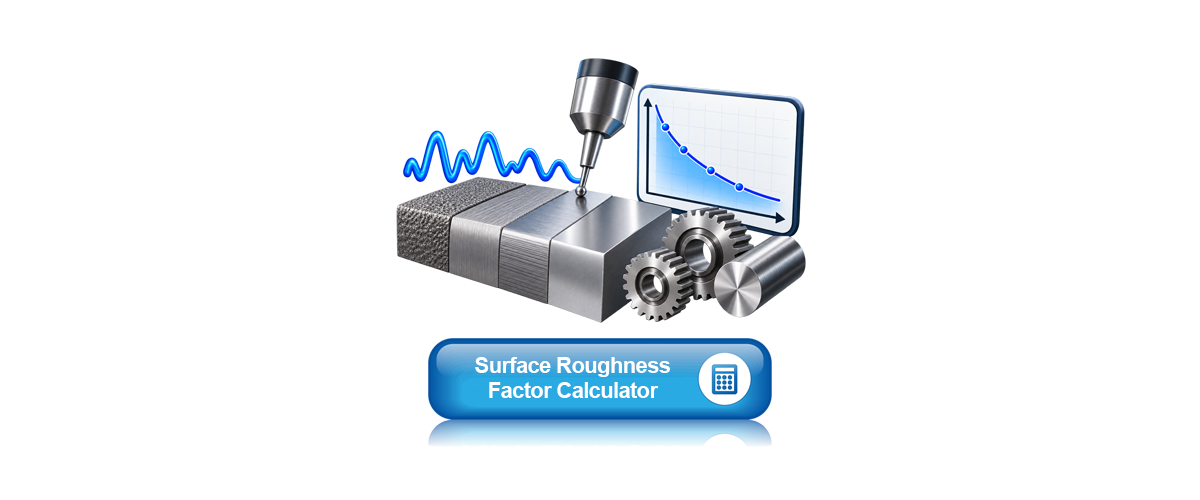
The Surface Roughness Factor Calculator is a practical engineering tool designed to estimate the influence of surface finish and roughness on the fatigue strength of metallic components. Using empirical surface modification factor equations, this calculator helps engineers evaluate how different manufacturing processes, including grinding, machining, hot rolling, and forging, affect material endurance strength. By entering ultimate tensile strength and selecting a surface finish, users can calculate the estimated surface modification factor (ka), fatigue strength reduction, and surface-corrected endurance limit. Ideal for mechanical engineers, material scientists, and manufacturing professionals, the Surface Roughness Factor Calculator supports preliminary fatigue analysis, material selection, and mechanical component design optimization. Improve engineering efficiency and make informed decisions with reliable, formula-based surface finish evaluations.

Input parameters

Choose a calculation mode. The two modes are kept separate: the manufacturing-process coefficients in Mode A are not functions of Ra.

Calculation mode
Stress unit
Used for Sut and Se′. Values are converted to MPa internally (1 ksi = 6.894757 MPa, 1 psi = 0.006894757 MPa). Switching converts the values already entered.
The Mode A coefficients were fitted to steel test data. Other materials need a material-specific model, entered in Mode B.
The tensile strength of the material in its final heat-treated condition. In Mode A, higher-strength steels are more sensitive to surface irregularities, so ka falls as Sut rises. Mode B does not use it in the formula.
The final manufacturing process at the critical location. Each finish has its own empirical a and b coefficients. Cold-drawn uses the machined coefficients.
The arithmetic mean deviation of the measured surface profile (for example per ISO 4287 or ISO 21920-2). In Mode A it is shown for reference only and does not change ka.
The endurance limit of polished, unnotched rotating-beam specimens, from test data or an accepted estimate. If you enter it, the calculator also gives the endurance limit corrected for surface finish only.